
Pepers' Pedals Dirty Tree review
A hand-built boost from New Zealand with two modes, and the TC mode is the one I use, because it gives me real control over what the boost is doing.
Disclosure: Bought with my own money, secondhand. Pepers' Pedals had no input and didn't see this before it went up.
Buy it. Blame me.
The Pepers' Pedals Dirty Tree is a 4.9/5: super badass, one of my favorite boosts on the market and well worth your money. The only reason it isn't a 5 is that it's a pedal that's not going to be for everyone. Skip it if the sound it's going for isn't the sound you're after.
Prefer YouTube? Watch How to Dial in the Dirty Tree on YouTube.
The short version
Good
- TC mode gives you real control over the bass and treble
- Turning up the level adds a subtle grind to the tone
- Sturdy enclosure and a footswitch that feels high quality
Bad
- Its particular sound might not be what you're after in a metal boost
Specs, briefly
The Pepers' Pedals Dirty Tree Boost is a $149 hand-built boost pedal from Dunedin, New Zealand, with a fixed-EQ DT mode and a TC mode with bass and treble, tested through a Peavey 6505+ and a Marshall MF280.
| Product | Pepers' Pedals Dirty Tree Boost |
|---|---|
| Category | Boost pedal |
| Price | $149 direct from Pepers' Pedals, October 2026, before shipping and any US import tariffs |
| Made in | Dunedin, New Zealand, hand-built to order |
| Modes | DT (fixed EQ, level only) and TC (level, bass and treble) |
| Controls | Level, low, high and a TC/DT toggle |
| Power | 9V DC, center-negative, any BOSS-style supply. An internal charge pump runs it at about 33V |
| Connections | Input, output, 9V jack, on/off LED |
| Tested with | B.C. Rich Bich NJ Series (DiMarzio Crunch Lab), ESP E-II M-I (Fishman Fluence Modern, Voice 1) and a stock Agile Intrepid eight-string, into a USA Peavey 6505+ and a Marshall MF280 cab |
| Tunings | Eb and C# standard on the six-strings, F# and F on the eight |
| Time with it | About five to six hours over separate sessions, at home |
| Video | How to Dial in the Dirty Tree (1:46) |
Maker's figures are from Pepers' Pedals' product page, checked October 22, 2026. Anything marked measured is mine. Ratings explained on the Blame Westad scale. Reviews get a dated note if anything changes.
How I tested it
I put about five to six hours on the Dirty Tree at home before writing this, spread out over separate sessions, not all in one sitting. After the cupcake phase, the sunflower phase, the lollipop phase, whatever the hell you want to call it.
Six-string duty was a neck-through B.C. Rich Bich NJ Series from the 2000s with a DiMarzio Crunch Lab in it, and an ESP E-II M-I with a Fishman Fluence Modern on Voice 1, the modern active voicing. For eight strings I used a stock Agile Intrepid, the blue and purple one, with its stock pickups. The six-strings were in Eb and C# standard, the Agile in F# and F.
Everything ran into my USA-made Peavey 6505+ from the 2000s and a Marshall MF280 cab.
Build and feel
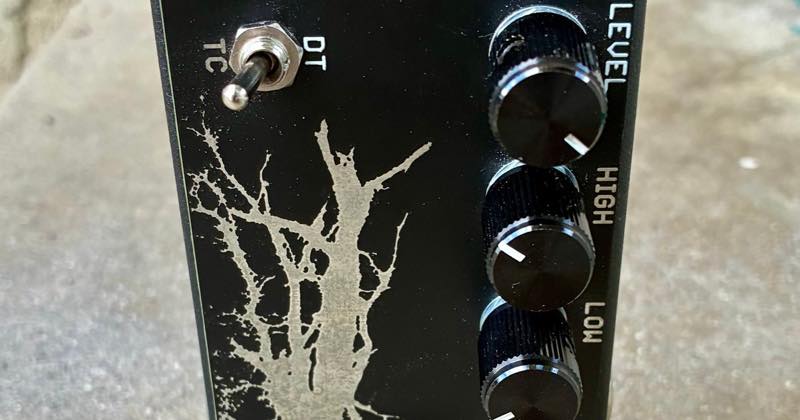
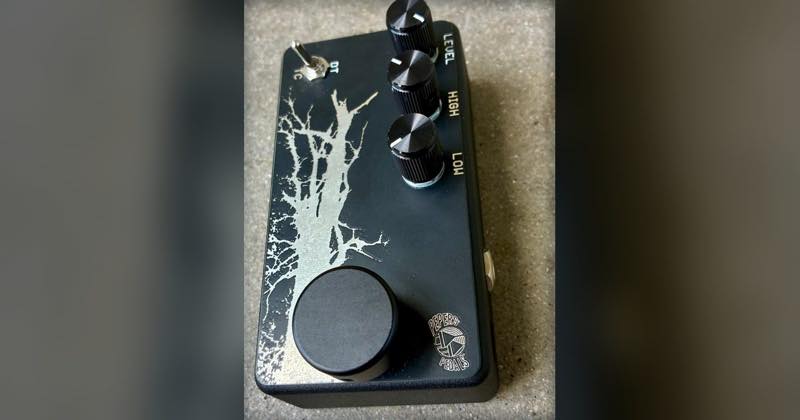
Pepers' Pedals is one guy in Dunedin, New Zealand, hand building pedals to order in his free time, and the Dirty Tree feels like it. Mine is sturdy, nothing rattles and the footswitch feels very high quality.
I bought mine secondhand and it came with the box. It's the version with the black background and the exposed metal tree, and it looks very metal. The other finishes look cool too.
It's simple on the outside: an input, an output, a 9V power jack and an LED on the front that tells you whether it's on. Inside, a charge pump takes that 9V up to about 33V, which is why Pepers calls it a high voltage boost.
Sound
The way I understand it, this pedal is chasing two things: the TC Electronic preamp booster Meshuggah made famous, and the Fortin 33 that grew out of it. Pepers doesn't name them. The product page just says it combines two pedals that are hard to find or too expensive into one box. For the lineage, Mårten Hagström has said the TC preamp the band used was the template for the 33, with some changes.
Two modes. DT mode shuts off the bass and treble knobs and runs a fixed EQ, so only the level is live, the way a 33 works. TC mode turns the bass and treble back on. The way I use those knobs, noon is the zero position. Turn one down toward 9 o'clock and you're cutting that end, turn it up toward 3 o'clock and you're adding to it. Pepers doesn't publish that, so take it as how I run it.
The Fortin 33 got a reputation because people plugged it in with their normal amp settings and tried to use it like a Tube Screamer. That doesn't work, especially for Meshuggah-style stuff. Lower the gain on the amp and bring the amp's bass up. That's your starting point.
DT mode works great on an eight-string if you want that Fortin tin can type of sound, which that crew seems to love. Personally I live in TC mode, because I want control over what the boost is actually doing. Cutting bass on the pedal tightens up the low end for modern metal, which is what most people are chasing with a Tube Screamer-style boost anyway, and here I get to decide how much instead of taking the fixed EQ.
Treble I start at noon and move depending on the amp. If the high strings get ice-picky, I leave it at noon or back it off a touch. If the chugs aren't chuggy enough, I push it up a little, and that extra high end changes the whole character of the sound.
Then there's the level. Turn it up and you get this subtle back-end grind in the sound. It's subtle, but it's very badass for metal.
Is the Dirty Tree good for metal?
Yes. That's the whole point of it. TC mode gives you a metal boost you can shape to the amp, and DT mode gets an eight-string into Fortin territory fast. The one thing to know going in is that it has a particular sound, and that sound might not be what you're after in a metal boost.
Dirty Tree vs the alternatives
- Maxon OD808X: the Tube Screamer route. Pick it if you want the usual tight-the-low-end boost that works with your amp's normal settings, no re-dialing required.
- Neural DSP Fortin Nameless Suite: the plugin route to the Fortin sound. Pick it if you're recording direct and want that flavor in the box instead of on the floor.
I've run all three. The Dirty Tree is the one that stays on the floor in front of the 6505+, because it does the Fortin thing and still lets me shape it, in a box one guy hand-built.
Verdict
For what it does and what you're paying for a hand-built pedal, the Dirty Tree is a 4.9 out of 5. The only thing keeping it off a 5 is that it's not going to be for everyone. It's super badass, I really enjoy it and it's one of my favorite boosts on the market. Well worth your money, and I'd tell you to pick one up, especially secondhand. New ones are $149 direct from New Zealand before shipping, and Pepers' site currently warns US buyers about import tariffs on top.
Reviewed by Westad, the metal guitarist behind Blame Westad. How I test gear: How I review.